Wednesday, 26 March 2014

Random Ramblings #11: STOMPY ROBOTS!

Whoa it seems to be that time of the month again! It's time for the RANDOM RAMBLINGS! This time, we delve deep into the Titanfall release, I'm hyped for something again, and some updates about what I'm playing. Let's not wait anymore!

Titanfall Release

Titanfall was released earlier this month, and I've played a number of games of it since then. I still love the gameplay of Titanfall, and everything I said about gameplay in the beta still stands. The maps are nicely varied, with some more suited to combat in the Titans, and others suiting pilots far more. Everything in the game runs very solid, even on my slightly older PC.

I mentioned the servers being an issue in the beta. They are still an issue now, even though Microsofts Azure system is very stable, with latency fluctuating between 80 to 170 that I have seen. There was one match where I had a latency of 290 the whole game. The other part of the game I strongly dislike (if not outright hate) is the campaign mode. Finding groups was a pain when I played through it, and more often than not, people leave if they get steamrolled repeatedly.

That being said, playing attrition (the game's version of team death match) is heaps of fun, and I love being able to just drop into a few games. I'd still recommend Titanfall if you want a FPS experience that is different to most others out there.

Heroes of the Storm

I love MOBAs. I love the teamwork required to win. I love the elements of strategy and reflexes required to succeed. And most of all, I love the uniqueness of each of the characters. You can go from playing a tank who just cannot be killed, to a glass cannon who demolishes a health bar in three hits. And now Blizzards MOBA, Heroes of the Storm (or Heroes as they call it to stop confusion with Heart of the Swarm), is in tech alpha. I cannot watch enough streams, read enough blue posts, browse enough sites to contain my hype for Heroes.

Blizzard are famous for taking an established concept and refining and polishing it until it is so damn shiny you cannot resist. Heroes seems to be no exception to this. Removing items in favour of a talent system, having team XP and removing the need for gold all indicate that Blizzard want to streamline the game and make it overall a more casual experience. And there's nothing wrong with that. Perhaps a casual experience will help to sate some of the rage that MOBAs are famous for.

All in all, I cannot wait for Heroes, and that leads into my next topic.

Games that Tetris is Playing

Because I'm so hyped for Heroes, I've been playing League of Legends again. I played League basically when it was released, but stopped a while back after it got super popular due to the community. I'm not a fan of going into a game to get raged at, or even see others get raged at for 45 minutes. There is nothing fun about that. Fortunately LoL appears to have calmed down a touch, although I have had two different occasions where people rage quit due to someone feeding.

Along with LoL, I've been playing the South Park game. It's... uh... different. The gameplay is so simple that it just works, and the humour is just as South Park as ever. I did encounter one particularly amusing bug that stretched all the textures on one characters face, but other than that the game is stable and solid. If you like South Park, you will love the game.

Last but not least, Diablo 3 had patch 2.0 drop, and it changed everything. The auction house is gone, and with it the old loot system. Because Blizzard no longer needs to balance everything around having the auction house, they can target loot more toward the character you are playing. This doesn't mean you are going to get nothing but loot to suit the character you are playing, but the chances of you getting the loot you need are far higher. I also never tried the old crafting system in D3, but the current crafting system is simple to use and easy to get into.

With patch 2.0, Blizzard also launched the Australian servers, meaning that the game is actually playable. Previously I would rubber band all over the place, disconnect frequently and just generally have a bad time. Now I get rock solid pings, hardly ever disconnect and the game is far better for it. Thank you Blizzard for actually listening to fans.

As always gentlefolks,

GAME ON!


Tuesday, 18 March 2014

Hearthstone Decks: A Newbies Guide

So, you've joined Blizzards latest release and installed Hearthstone. You may have even played the tutorial and defeated Illidan in epic card based combat. Now you are dumped into a menu and you have no idea where to go from there. Hopefully this guide will help you to get the basics of building decks, and then introduce you to some more advanced concepts of making decks in Hearthstone. So let's start with what you are looking at on the most common type of card you will be using: the minion card.

Minion Cards:
Minions are exactly what they sound like: creatures that you control who fight for you. Each minion card has 4 main things on it, besides the artwork on it. They are:

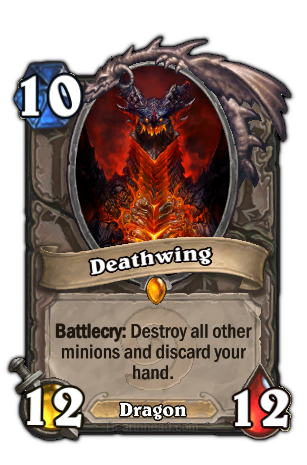
1. Mana Cost: Every card in the game has a mana cost. Found in the top left, this indicates how many mana crystals will be used up when the card is played. Hearthstone has a mana system that gives you one crystal each turn. If you played the tutorial, then you know all about that. If you haven't, then for now all you need to know is that doing anything requires mana crystals. Deathwing shown in the picture, costs 10 mana.

Deathwing, also known as "Oh, what happened
to my hand? CRAP I NEEDED THAT!"
2. Attack power and Health: A minion's attack power and health are shown at the bottom of the card; attack power on the yellow circle, and the health on the red drop. The attack power does exactly what it sounds like. When you command a minion to attack it will deal the amount of damage listed there. If a minions health drops to zero, it will die and be removed from play. Deathwing has a massive 12 attack and 12 health.

3: Ability Text: Not every minion card has text written on it, however those that do will have it below the name. There are a number of different effects that are in the game, and I will touch on them here:

  • Battlecry: This card will do something when it is summoned to the board.
  • Charge: You can attack straight away with a charge card.
  • Choose One: An ability on Druid cards, you select one of the effects on the card.
  • Combo: Rogue cards can have extra effects if you have already played a card this turn.
  • Deathrattle: This card will do something when it dies.
  • Divine Shield: The first damage this card takes is negated. Basically gives a card two lives.
  • Enrage: Damaging these minions makes them angry, giving them the effect stated.
  • Freeze: Something frozen cannot attack for one turn.
  • Immune: Cannot be damaged.
  • Overload: A card with Overload (2) will use two mana on the next turn, in addition the the mana listed on the top left. Found only on Shaman cards.
  • Silence: Removes any text, buffs, and abilities from a minion. Very useful.
  • Stealth: Cannot be targeted until they deal damage. They can still be hit by AoE.
  • Spell Damage: Increases the damage of spell cards by the amount listed.
  • Summon: This card will bring another minion into play.
  • Taunt: Must be targeted before anything else.
  • Transform: Changes a minion, removing all text and enchantments.
  • Windfury: Can attack twice on a turn.

4: Card Type: Shown in the picture between the attack power and health, the card type will vary from card to card. For example, on Deathwing, it's type is shown as Dragon. There are other types including Murloc, Beast and Pirate cards to list a few. For now, Beast and Murloc types work well with each other in certain decks, and you can be sure that Blizzard will expand on this as they release more card sets in the future.

The heroes that you choose will often affect the minion cards that you put into a deck. For example, a Hunter would definitely want to have a good selection of Beast cards, as many of the spell cards that a Hunter has need Beasts to work most effectively. Alternatively a Mage would have no need to have lots of Beasts, but may take a couple if it works with the deck. This leads right into the differences between the classes, as they can also have an impact on how they play.

Class Differences:

Hearthstone differs from a lot of the other CCGs out there by adding classes to the mix. Each class has a unique ability that costs two mana crystals to use. The abilities are as follows:
  • Mage: Fireblast. This does 1 damage that can be targeted anywhere by the player.
  • Warrior: Armour Up! You gain two armour that acts as a buffer to your health.
  • Rogue: Dagger Mastery. Equips a weapon that can do 1 damage twice.
  • Priest: Lesser Heal. Restore two health where ever the player targets.
  • Warlock: Life Tap. Deals two damage to the player, and allows them to draw a card.
  • Paladin: Reinforce. Summons a 1/1 minion token (the Silver Hand Recruit).
  • Druid: Shapeshift. Gives the hero 1 attack and 1 armour.
  • Hunter: Steady Shot. Deals two damage directly to the enemy hero.
  • Shaman: Totemic Call. Summons a random totem card to the board.
These abilities should always be used if you have no other options on your turn, or if you have the spare mana available. Along with the abilites, all classes have cards that are unique to them. These cards usually work well with the class, and should always be considered when making a deck.

Spell Cards:

Spell cards are the other type of card that you will be using. There are a wide range of spell cards in Hearthstone, that all do very different things. Some cards buff minions, while others destroy enemy minions. There are secrets that get played and only activate after a certain action is taken by your opponent (think trap cards). To give you a better idea, here are a few spell cards available in the game.

So many choices!
As with minion cards, each spell card has a mana cost shown in the top left of each card, and the cards text tells you what it does.

Weapons:

These cards are neither minions or spells, but are similar to each of them. They provide your hero with the ability to attack for a limited number of times.
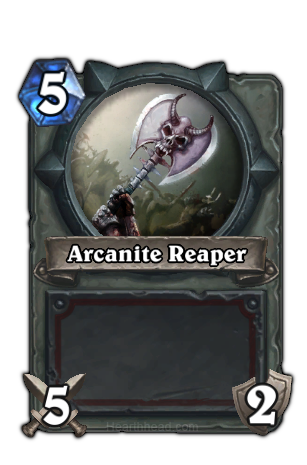
As with minions, you have a cost in the top left and the attack power in the bottom left. The biggest difference however, is the durability of the weapon listed in the bottom right. When you use the weapon, a point of durability is taken off it. When that number reaches zero, the weapon breaks, and is removed from play. When attacking with a weapon, the hero acts exactly as a minion and will take damage if it attacks another minion (with one Hunter weapon being the sole exception at this time). Using the additional damage that a weapon can give could be the difference between winning and losing. Warriors and Rogues especially benefit from the use of weapons.

So you've chose what class you want to try, and know what the different types of cards are. Now we move on to building a deck.


Deck Building Basics:

Building a deck is a game all of it's own. It takes a good knowledge of how cards work together and how to get the right mix of cheaper cost cards with more expensive ones. While this guide is aimed at new players, it still pays to know the different types of decks that can be made in a CCG. There are 3 main types of deck that can be played: Aggro, Control and Combo.

Aggro decks are exactly what they say on the box. These decks are super aggressive and try to drop a players health to zero as fast a possible. Most players will use a combination of low cost minions, spells and weapons while focusing the majority of damage to the opponents hero and drawing additional cards when they can. Playing an aggro deck is risky. If the opponent can delay to the late game, most aggro decks will run out of legs and find themselves without the ability to deal with what is being thrown at them. If you get the right cards however, you will find that your opponent cannot deal with the amount of damage that you are putting out.

Control decks are the opposite to aggro decks. Generally speaking, where aggro decks are ignore what the other player is doing (to a point), control decks are reactive to what your opponent does (requiring you to "control" the board). This could be by removing minions, utilizing abilities or spells to reduce or heal damage, and finally getting to a point where you can deal lethal damage. I personally love playing control decks. The feeling of satisfaction from making the correct choices to finally win cannot be compared.

Combo decks are generally one trick ponies that use a very special combination of cards to win. Some times called one turn kill decks (or OTK), these decks often use cards that allow you to draw additional cards each turn to try and get the magic combination to win. The skill in these decks comes from being able to delay until you can use the combo. However expect to lose a lot of games with Combo decks, as a run of bad luck can mean you don't get the cards you need to win.

There are also decks that use a mixture of the three main deck types. Called hybrid decks, they are generally not as focused as a deck that is only using one style of play. However that doesn't mean that they aren't as effective. If built efficiently, they can be just as lethal as any other type of deck.

An example of a typical Mana curve.
This one has less 5 mana cards than I would normally like.
One of the biggest things to remember when building a deck is to have a balanced mana curve. A mana curve is a simple way to show how many cards of various costs you have in a deck. You don't want to have a full deck of cards costed at 1- 3 mana (as you would struggle if the game goes longer), or costed at 7 - 10 mana (as you wouldn't be able to play anything until at least turn 7). Having a nice even curve means that no matter what point you are in the game you should have something you can play. The cards you want the most of would normally be between 3 - 6 mana, with a nice curve up and down on either side.

Another important part of making a deck is knowing what cards work well (or synergise) with each other. If you simply throw a bunch of cards into a deck, then there is little chance that anything will work together. This is why I mentioned the 3 main types of deck. As an example, when making my control mage deck, I had a goal in mind. I wanted to use the powerful spell cards that the mage has to both control the board and finish the opponent off. To do this, I knew I needed cards that would buff the power of these spells, minions that had taunt to stop any other minions from damaging me, removal to get rid of any big creatures that my opponent might play and finally big damage spells or minions to finish them off. Once you have a rough idea what you need, you can start to look through your collection for cards that do this, but also synergise with each other so that no matter what order they are drawn in, you have a chance to win by making good choices.

Would You Like to Know More?

So that's the basics, and if you dive in headfirst everything here will start to make sense. If you want more information, there are a number of places that you can go. For starters, Hearthhead is a great resource to know what cards are in the game. All of the pictures in this guide came from Hearthhead. Massive thanks to the guys behind it for that amazing resource. It made writing this guide so much easier!

If you like podcasts, I would highly recommend The Angry Chicken. Garret, Dills and Jocelyn have a great show there, and it is squarely aimed at the casual player that wants to get better. At the time of writing, there are 23 episodes, and each one has a very useful strategy segment that goes into one particular part of the game. Not only that, but they have great synergy (haha).

And last but definitely not least, Hearthpwn has a great decklist sharing tool. I tend to not follow the netdecking trend that has surrounded Hearthstone since day one, as I enjoy building my own decks. However, with that being said, looking at other peoples decks can give you ideas for how to change your own decks to better deal with a particular problem you might be facing. And if you find a particular deck that you think you will really enjoy, you can give it a go.

Building a really strong deck is a rewarding experience. Hopefully you can use the information here to make a start on it, and can get into the amazing world of building a deck. As always folks,

GAME ON!

Tuesday, 11 March 2014

The Mindset of Eve vs WoW

It's no major secret that I came to WoW from Eve. I started playing Eve in late 2006, left and came back all in the space of 6 months in 2009, and while I am still subbed, I don't play as much now. It was, and still is, a fun game to play, so long as you had others to play with. As my Eve gaming group got smaller, my enjoyment of the game lessened to the point where I was only really interested in things like the CSM and the space politics of nullsec. When I started playing WoW, it was with the intention to play mostly solo. Of course, me being me, I couldn't resist the urge to jump a little deeper into the more involved parts of the game.

Why the nostalgia trip? Well I still love to read up about Eve, and came across this ALOD article on TheMittani.com that I just had to talk about it. Here's a link to the actual kill. The total ISK value of this ship clocks in at around 44 billion. For those who know nothing about Eve, the largest ships in the game (Titans) cost around 100 billion isk for the hull. So this kill is almost half the amount of a Titan hull. To buy the ship and fittings with PLEX would cost a tiny bit less than $1,150 US. And the worst part, if you read the rest of that article, he did buy PLEX to pay for it, which means real money was lost in this kill. Sigh...

I've always found that the biggest mistake WoW players make in Eve comes down to a difference in mindset. WoW is such a curated, policed world, where any scams are reportable, theft is against the rules and any lost items are returned. You choose to engage in PVP, either by joining a PVP realm or turning on your PVP flag. There is no real loss if you die, just a small repair bill and a run back to your corpse or instance where you died.

Gear too is important. Having the best gear in the game directly affects how much damage you do, how much damage you can take and how much healing you can do. To be the best, you need the best. Even one green item can set you back in how well you do, and replacing any out of date items becomes a game of its own.

There is absolutely nothing wrong with all of this. Logging into WoW for an evening is such a good way to relax and unwind after a day that millions of players do it. I personally find WoW to be a better way to spend and hour of time than Eve ever was. Longer time periods feel more rewarding in Eve definitely, as some things can take months to return value. But to get home from work and then run two or three old raids in WoW feels better than to spend the same amount of time updating buy and sell orders in Eve.

That being said however, you simply cannot expect to play Eve the same way. It's generally accepted that missions in Eve (the closest they have to questing) are terrible. The gathering (that's mining essentially), is literally hours of sitting in one spot watching mining lasers cycle. Even solo PVP is hard, and while there are those who do it, it takes time to learn how to be effective at soloing. The world too is completely different. Even the so called "safe" areas of Eve, high security space, can be dangerous. Suicide ganking, the act of destroying another players ship before your ship is destroyed by the space police, has been ruled by CCP as a valid gameplay element in high sec.

Your ships modules (the Eve equivalent of gear), play a lesser role in how well you do than how you design your fit, and then how you fly it. Using officer modules (like the person in ALOD post) makes a very small difference to how well you do. Just because something is purple or green doesn't mean that it will make you do heaps more damage or live longer in a fight.

Eve is such a unique game that it really needs to be tackled in a unique way. You cannot come to Eve with the same mindset as WoW, and if you do, then you will more than likely come away hating the game. Come into the game with the right attitude however, and you will find some good times, good people and a community that is like no other. Just don't be like Mr Jimblidge, who I'm sure is firing up his secret lawyer contacts to find out who I am in real life because I wrote this.

As always,

GAME ON!

Monday, 10 March 2014

Gearing up in MoP: A Newbies Guide

This post was written and ready to be posted last week, well before before the preorders for Warlords went live. I have made several adjustments to the post to reflect the changes that we know about since the level 90 boost went live.

So, you've just got your character to 90. Congratulations, and welcome to the club. However if you are anything like me, you now have no idea what to do. You want to raid, you want to make gold, you want to solo old content, you want to smash challenge mode dungeons, or you want to just dance naked in Orgrimmar. Either way, you should probably replace those terrible greens that you got from that random grummel in Kun-Lai. You need to gear up.

When I first heard the term "gear up" I had no idea what it meant. Little did I know that it was something that dictates so much in WoW. Gearing up is simply the process of obtaining better gear to do whatever your endgame in WoW is. For most people, that means getting into LFR, or maybe the occasional Flex raid. For others, it might be doing PvP (although the process for gearing up in PvP is a little different). Or you might be looking to raid with the tip top heroic raid teams. My experience is very much centered around the casual player, running some LFR, old content, and jumping in a Flex every now and then. This guide will focus purely on the PvE side of gearing up.

The general process of gearing up is increasing the average level of items that your character is using. Every piece of gear has an Item Level, also known simply as "ilevel", listed in the information of the item. In your character information screen, you will also see an average of this number listed in your stats. So when people say "550 Hunter looking for group", they are saying they have an average ilevel of 550.

In Mists of Pandaria, Blizzard has added a number of options to gear up a character. Let's go through them now:

Timeless Isle:

Or as I like to call it, land of the lost loot. Timeless isle was added in 5.4 as a shortcut to get gear and the finish of the legendary cloak questline. Everyone who hits 90 should immediately head to TI and open the chests there. There are a bunch of chests that can be opened once per character, as well as two chests that can be done each week. If you want a nice easy way to get all the chests, I would recommend this guide at MMO-Champion. Simca and Tziva have done a fantastic job of making it easy to get all the chests with TomTom waypoints for each chest.

As well as the chests, pretty much every mob on the island has a chance to drop a token for armour, rings, cloaks, trinkets and necks. These tokens will provide you with a piece of 496 gear to suit the spec chosen when you convert it. To set your spec, you can either be in that spec or right click on your character portrait, then selecting the spec you want loot for under "Loot Specialization". So if you are playing a Hunter, you can select Default (the spec you are in at the time), Survival, Beast Mastery or Marksmanship. This is important, as depending on what role you want to play, you may need to change the spec to get the correct stats on the gear.

Timeless Isle also gives you at least one piece of 535 gear by upgrading a token with a Burden of Eternity. This must be done while the piece is still a token, and once a piece of armour is created, it cannot be returned to a token. There is one guaranteed Burden in the Blazing Chest (marked 7 in the guide linked above), and each rare on the island has a chance to drop one. You can also purchase them for Timeless Coins, a currency dropped by everything on the island, as well as being given as a quest reward. The Burdens cost 50,000 coins, and are purchased near the Celestial Court from Mistweaver Ai.

Additionally, Mistweaver Ai sells a 535 Trinket (50,000 coins), 489 weapons (20,000 for Two Hand, 10,000 for One Hand and Shields), and Cloth, Leather, Mail and Plate Armour Caches (7,500 coins for a random piece of armour). Most people disregard the weapons, and I tend to agree, unless you have the spare coins and are particularly unlucky with loot drops.

It's not unusual for many to be able to go to the Timeless Isle, and leave able to queue for LFR. That being said however, there is another avenue to gear up to get into LFR.

Heroic Dungeons and Scenarios:

If you don't like killing lots of mobs on the Timeless Isle, you can kill lots of mobs in heroic Dungeons and Scenarios. The dungeons are the more traditional way of gearing up. Each heroic dungeon boss drops loot of ilevel 463 and each piece can be upgraded with Justice Points to an ilevel of 471. It's certainly not the best loot in the game, but it can help to replace that last green that you couldn't replace on the Timless Isle. In my opinion however, the biggest advantage to running heroic dungeons is the Valor Points you get. These points are used to upgrade gear, but I will get more into that later. Needless to say, getting and using this Valor is one of the cornerstones of gearing up in WoW. Just as small side note, if you boosted your 90, you will already have green gear of ilevel 483, so dungeons will not provide any gear upgrades for you. However if you need a quick boost of Valor, dungeons are by far the fastest way to grind to Valor cap.

Heroic Scenarios are a little harder to organise. Where you can simply queue for heroic dungeons as soon as you hit 90, you need a pre-made group to get into a heroic scenario. Requiring 3 players to work together, the roles in scenarios are a little more lax, although I would recommend that at least one of you is a healer, just to make everything run that little bit smoother. The loot system in scenarios revolves around the Heroic Cache of Treasures. When you open it, you get a chance at a piece of epic gear at ilevel 516 to suit the Loot Specialization you currently have selected. If you don't get gear from it, you will get small amount of gold.

After you hit a certain average ilevel, you will be able to queue for LFR. Boosted characters can jump straight into LFR for the Throne of Thunder and older raids. The ilevel requirements for each wing of LFR can be found in the Raid Finder window, or this page of Wowpedia has a full list of the requirements for each raid.

LFR and Flex Raids:

So you jump into LFR, down your first boss and this appears on your screen:
Thanks to TenTonHammer for the pic
That is the Personal Loot system that all LFR and Flex raids use. Rather than everyone rolling on the same loot, everyone in the raid has a personal loot roll that only affects you. You will either get a piece of gear, or a cache that contains gold. Each time you do this you can also use a Bonus Roll, paid for by a special type of currency. The currencies are Elder Charm of Good Fortune for Mogu'Shan Vaults, Heart of Fear and Terrace of Endless Spring, Mogu Rune of Fate for Throne of Thunder, and Warforged Seal for Siege of Orgrimmar. Each of these currencies can also be used on certain world bosses around Pandaria.

If you've been doing the Timeless Isle, or you boosted your character, you will more than likely be able to get into Throne of Thunder, which means you will be rolling for 502 level gear. Hopefully after a couple of LFR runs you will be able to reach the 496 requirement for Siege of Orgrimmar, where you will be able to roll on 528 level gear, a huge jump from the ToT loot.

When you finally exhausted any LFR loot upgrades, Flex is the next step. Flex raids require you have a pre-made group of at least 10 people, but then allows you to have any number of people from 10 to 25, meaning that if someone needs to leave you can continue raiding. Flex also uses the same loot system as LFR, with Warforged Seals giving you another chance at gear from a boss you have just defeated. Flex gear is at a fantastic 540 ilevel.

The Next Step?

So you have a set of gear that consists of LFR, Flex and maybe some 535 Timeless pieces. What do you do now? The short answer: reforge, gem and enchant. Every class has certain stats that work best for them, and there are plenty of guides on what stats to focus on. My personal favorite place to look is Icy Veins, as they have detailed guides for each spec for each class on there, including stat priority, gems and enchants to use and even some rotations to help you play your class better. You can also use Valor points to upgrade your gear. This will raise the ilevel of the gear, and increase all the stats by a certain amount. Most pieces of gear can be upgraded twice, for a total of 500 Valor.

I hope this guide will help you to figure out a way to get the gear you need to do what you want. As with all of my guides, this not intended to be set in stone, and everything can be changed to suit your play style and how you want your end game to be.

As always folks,

GAME ON!

Friday, 28 February 2014

Soloing Old WoW Content: A Newbies Guide.

If you know me in game, or have been reading my blog since I started talking about WoW, you probably know that I enjoy running old content. I especially love soloing older raids and dungeons. A big part of the reason I enjoyed WoW at first was the ability to go back and run old raids to get the gear and pets from them. As I've matured in WoW my focus has changed to other things, but I always try to run the old content whenever I get the chance. Hopefully this guide will help you get into running old content if you feel like that part of the game is something you will enjoy.

Why run old content?:

If you read my gold making newbies guide, you may remember that I touched on running old content as a way to make gold in WoW. It's not the best way to make money, but it is the most engaging in my mind. While running old content you can make money from vendoring soulbound loot, auctioning BoE loot and pets, and the actual gold drops from both trash mobs and bosses.

Gold isn't the only reason to run old content. If you like lore, raids and dungeons can expand on that and allow you to live parts of WoW's history. My personal favorite villain in the WoW lore is Illiden, followed closely by Ragnaros. I've soloed both of them, and each time it was a ton of fun.

But wait there's more. Depending on how old the raids are, they can be a challenge and if you like a challenge, they are extremely fun. Some fights are tough to solo for most classes, especially the ones that have constant damage, or a massive spike in damage. The hardest fight I ever had was when I first hit 90 and tried to solo Gruul the Dragonkiller. My gear was terrible (at that point I still had some green pieces), and I wiped 3 times. Eventually, I came up with a way to mitigate a lot of the damage by switching some talents and changing my hunter pet. I would never have had that experience if it wasn't for trying to solo something.

How to get started:

So my little talk there has convinced you to start running old content solo. But you have no idea where to start. This is where it gets a little tricky, as what you can and can't solo depends on your class. If you are a Blood spec Death Knight, you are going to have no trouble soloing most things. My personal choice of class, the Hunter, can solo a good amount of old content and even some current level normal dungeons, as we have a pet to tank a lot of the damage for us. The cloth wearing classes are going to find it the hardest (although I have it on good authority that a Disc Priest can solo a fair bit with their self heals).

Besides the class you choose, the gear you wear makes a huge difference to how easy old content becomes. The fight with Gruul I mentioned came down to how bad my gear was at the time, and now that I am around 530 average ilevel, that fight takes me all of 20 seconds. Where previously a full clear of Molten Core would take me around 30 mins, it now only takes me about 15 mins. Getting better gear also opens up content that you wouldn't have been able to solo before. I tried to solo a Mists of Pandaria normal dungeon around the same time that I soloed Gruul (feeling that now I had taken down a hard boss I could solo something current haha), and had my ass handed back to me in a paper bag. These days I can solo a couple of normals, and it wouldn't surprise me if someone with full normal or heroic gear could solo all of the dungeons that mists has to offer.

To begin with, I'd recommend soloing dungeons. Heroic dungeons in WotLK offered several mounts that you could solo for, and are a good starting point of difficulty. Every single level 90 character should be able to solo them with little to no difficulty at all. After that, have a look at Molten Core or Ruins of Ahn'Qiraj (AQ20) for something a little more difficult. As your gear gets better and better, start to take on more challenging raids and working toward more difficult things.

Speedrunning:

This is where I've started to find my most enjoyment from soloing old content: attempting to do it faster and faster as you go along. Installing all the Deadly Boss Mod packages gives you a record of your fastest time taking a boss down. This can give you a good benchmark of how much better you are getting at content as you get better gear, develop better strategies and learn the fights. You can simply record times for each boss, or if you are like me, run a stop watch from start to finish of an instance to see if you have gotten better overall.

And that is pretty much all there is to soloing old content. You can start to solo harder and harder content if you research the fights and work out just how to do what you need to do. As always folks, run old content and...

GAME ON!

Friday, 21 February 2014

Random Ramblings #10: Two wrongs and a right.

It's leveled up! The Random Ramblings has reached it's tenth edition. In this one, I'm wrong about something in Pokemon,  I'm right (hopefully) about WoD's boost to 90 price, and I'm wrong about some big robots falling from the sky.

As a small aside before I continue however, I would just like to say a massive thank you to everyone who gave me feedback on my Gold Making post. I had well over 6500 views on that post alone in the two weeks it's been up and all of the people contacting me on Reddit, in game and on Facebook made me feel like I had helped a few people. I will definitely be continuing to post more newbie guides to WoW.

Without any further introduction, lets dive headfirst into this edition of the Random Ramblings.

Pokemon X and Y


I recently obtained a 2DS and a copy of Pokemon Y. If you've been reading the blog for a little while you know I am a huge Pokemon fanboy, and it is really my only handheld game obsession. X and Y have done a fantastic job of tapping into the group of players that started with Red and Blue all those years ago. How? Kanto starters. Being able to obtain all of the Kanto starters through one means or another makes this whole game a huge nostalgia trip for me.

The overworld gameplay has changed a whole bunch. Being able to move diagonally makes movement that much more interesting, and the roller skates as another movement type is also a great addition. As far as looks go, everything being rendered in 3D has only added to an already recognizable art style in the game. Where the game truly comes into its own however, is the battling.

I'm the first to admit, I was dubious about the mega evolutions that were added to the game. I really didn't see how it was going to add to the game, besides making some Pokemon look good. I'm also the first to admit, I was totally wrong. Mega evolutions add so much more in the way of tactics to the game. Being able to only mega evolve one Pokemon per battle, and then having that effect wear off if the Pokemon faints or is switched out means you need to use it at the right time to get maximum effect from it. The battle animations have completely changed, with all of the Pokemon being fully animated throughout the entire fight (think Pokemon Stadium style). Everything in the battles just feels better and more immersive.

All in all, I love Pokemon Y. It's just the right combination of old and new to make it an ideal Pokemon game for me. Here's to many more years of amazing Pokemon games.

Warlords of Draenor Leak

Now this isn't official, so take it with a pinch of salt. On Tuesday while the server maintenance was happening, people were able to log in for a few minutes and see the interface for character boosts. The following picture was posted on /r/wow and MMO Champion.

Obviously this is subject to change and by no means should be taken as the final price, but if the boost does go live at $60 I feel it's a good price. I'm a strong believer that pricing something so that people have to actually think about it is the best for a micro transaction in a game, especially for something like this. Pricing it around this does 2 things: 1: It stops people from just buying one of every class and killing the low level zones (something I mentioned in my Boosting to 90 post as being the only legitimate reason I could see boosts being bad), and 2: Still keeps it within range of everyone playing as an option.

The whole point of the level 90 boost is to give an option to skip leveling on a character if you needed to. But for it to be effective, it needs to be just that, an option. If every man and his alt is getting boosted, the low level zones suddenly become dead, dungeon finders are no longer an option for traditional leveling and WoW loses one of the best aspects: the story leading to max level. But if no one but those with the deepest RL pockets can afford to boost, it opens up a can of worms about imbalances (although how and why is never addressed by those people), Blizzard being greedy and general rage from the community. If it is $60 for a boost, then Blizzard has made a good choice in my opinion.

Giant Robots and Parkour: Titanfall


If I seem happy, I'm actually not. You see the Titanfall beta is over, and that means I have to wait until the middle of March to be able to play it again. That's like 3 and half weeks man. It's almost a month of waiting. I just don't know if I can make it.

I got into the beta 2 weeks ago, and despite my initial reservations, I really, really, really, really love Titanfall. Actually add a few more really's in there, and you might even come close to how I feel about it. My reservations about the game come from how I feel about the CoD style of multiplayer, and with the team behind Titanfall (Respawn) having a lot of the guys from Infinity Ward in it, I was worried that it would feel exactly the same as CoD.

To continue the theme of today's post, I was wrong. Titanfall is so much better than CoD. It retains the parts of CoD that make it brilliant (weapon customization, fast paced shooting), and adds jump jet assisted parkour and giant stompy mechs. The beta had 3 types of mech that you could play, but only one readily available in the Atlas mech shown in the picture above (the other two came from one use only cards that you unlock from gameplay).

The biggest issue with the game currently is the lack of Australian servers. All of the servers are done through Microsoft, and they currently have no data centers in Australia. This is being worked on, but if you do pick up the game before it is, expect to get anywhere between 100ms to 250ms ping. The netcode is rock solid however and with the exception of one or two games, I had no issues with it feeling as though I was lagging at all.

There really is no way to actually describe the feeling of playing Titanfall, as the only reference I have is playing Tribes or Brink. The fast paced movement that you can achieve in the game, combined with the feeling of power you get in a Titan add up to make Titanfall one of the best multiplayer experiences I have ever had. If you like FPS games, give Titanfall a go. You might be as happily surprised as I was.

As always,

GAME ON!

Saturday, 8 February 2014

Making Gold in WoW - A Newbies Guide.

When I started playing World of Warcraft last year, I came from a long history of playing Eve Online. A massive part of Eve for me was the manufacturing and mining sides of Eve - I was the stereotypical "carebear" player in Eve. The parts of the game that I found most fun were things like playing the markets, mining space rocks and making large sums of ISK. WoW also has those aspects, albeit a little more involved than Eve's crafting system. However as a new player, I had no idea how to tap into WoW's auctions, crafting and loot systems to make gold in the game. As I have progressed in the game, certain things became apparent, and I am going to do my best to write them from the point of view of the newbie to the game. This list is not going to include every possible way to make money in the game, as that list would be impossibly long and very hard to judge per server. So let's jump into the world of gold making in WoW.

Disclaimer: The following list should be read as going from easiest to hardest all the way down. Please don't take it as the be all and end all of making gold. There are literally thousands of ways to make gold that people have found.

Sell on the Auction House:

The Auction House in WoW is a very powerful way to make gold, and any serious gold maker will spend more time standing in front of the auctioneers in the major cities than they do anywhere else in the game. But that doesn't mean that you have to spend every waking moment checking auctions to make money there. While leveling my first character I made a mistake by selling everything to NPC vendors, and as I realised later I could have made a fair bit more gold from selling green items and blue items, low level crafting mats and other items.

Don't be afraid to put low level green items up on the AH. People starting new characters will often buy green items for their characters to fill slots they don't have BoA heirloom items for. People leveling enchanting will also buy gear to disenchant, or even enchant, if they need something quickly. If you don't plan on leveling your professions right away, you could also sell cloth, cooking ingredients and reagents on the AH. Experiment with what sells on your realm, as results in certain items may vary. For example on my realm cloth is a sure seller, but ingredients are not. And the best part about all of this? Your character doesn't need to be at max level to take advantage of all of these things.

Run Old Instances:

If you don't like crafting, then the absolute best way to make gold on your own is running old raids and dungeons. Now while a max level character is not required to do this, having one that is max level and reasonably geared will make the entire process that much faster. I personally love to run AQ20 whenever I can as the effort required there is minimal, and the rewards from the grey and soulbound items can yield between 200 to 500 gold every run for around 10 mins of my time.

Another big advantage of running old raids and dungeons is the pet, mount and BoE (bind on equip) items you can get. The mounts are nice to have if they drop, and there are some really rare mounts out there that drop from raids. Both pets and BoE items should be sold in the AH (unless you want to keep them of course), to maximize profits. Again you will need to do some experimenting to see what sells on the AH and vendor everything else.

Carrying Others:

Probably the one I know the least about as far as making money off it, but I know of others who make money from carrying people through dungeons and arena PVP. While the dungeon one may not be as interesting with the LFG tool, you can still ask newbies in trade or local if they want to join you when you run old dungeons for a small fee. If you get the PVP bug, people will often pay to get carried through PVP, paying per win. A friend I have in game makes around 100 - 150 gold per win and will easily make 1500 gold in an evening of play.

Gathering Professions:

Now we get into the more involved part of making gold - anything involving professions requires a bit of an investment in time and gold to get started in. With gathering professions however, your gold investment is minimal, and you can sell most of what you gather straight away. The three gathering professions in WoW are Mining, Herbalism and Skinning. Introduced in Mists of Pandaria was the ability to level Mining and Herbalism in Pandaria. For example, you can mine Ghost Iron Ore nodes to get Ghost Iron Nuggets and then ten of these are combined to make a single complete ore. This has made it a lot easier to level both of these professions if you are already at level 90. Skinning is a little more annoying to get to max level as it requires you starting out by killing lower level mobs and skinning them. As your skill gets higher, so will the level of the mobs you need to kill to level it.

Making money from these professions is as easy as filling your bags with the items and selling them on the AH. Do not for any reason vendor these items, as you will make more money on the AH even on a day where prices are down. With mining, you may want to look at smelting the ore into bars, depending on the demand for bars on your server. Raw ores are used by Jewelcrafters, who form a large portion of those who are making large amounts of gold, so demand for raw ore may be higher for your realm depending on the population.

Crafting Professions:

When you become truly serious about making gold, crafting professions are a must. While I'm sure there are people who make gold without using the major crafting professions, at a certain point using those professions makes the whole process of making gold a lot easier. The different professions are as follows:

Jewelcrafting: In my opinion the most important crafting profession for making gold, Jewelcrafting involves making gems to be slotted in gear as well as trinkets, necks and weapons for people to use. Obtaining gems is done by prospecting raw ore, consuming 5 ore each time. The number of gems you get each time is random, but in my experience an average would be two. Combine Jewelcrafting with mining if you are playing around with one character and you will have a good way to make money easily.

Enchanting: Also a good one to use for making gold, enchanting does exactly what it says: you enchant gear to make it better. This can be done either by enchanting the item directly, or applying the enchant to a vellum (an item made with Inscription) to store or sell it. Enchanting is interesting for gold makers, as it allows us to perform something called the shuffle. I will go more into the shuffle later on in this post. The best part about enchanting is that it doesn't rely on any other professions to do what you need to do. Mats for enchanting are obtained by disenchanting gear of green quality or higher. The quality of the mats you obtain will vary depending on the quality and level of the gear. The biggest downside to enchanting is how hard it is to level. To gather the mats yourself will take a fair amount of time, and buying them off the AH becomes very expensive (at least in my experience). The investment here is well worth it when it comes to making gold.

Alchemy: Oh how I love Alchemy. I really wish I had taken Alchemy earlier in WoW. Best used to support your other professions, Alchemy is used to make potions, flasks and elixirs. These are used in both raiding and PVP, and as such are in constant demand from those who do not have a character who makes them. However its most powerful usage is the various Transmute spells you get with it. These abilities allow you to take a number of a common crafting item and make a rare crafting item with them. As an example, you can take ten Ghost Iron Bars and make one rare Trillium Bar. You can then take six Trillium Bars and make one Living Steel Bar. Alchemists make a lot of money by making these items that other professions need to craft their items. If you are going to be serious about gold making - and I mean with multiple characters, at least one should be an Alchemist, and any spare profession slot should be taken up with Alchemy.

Inscription: Do you love writing as much as I do? Then become a scribe today with Inscription! A really strange profession in my opinion, Inscription allows you to make a wide variety of things ranging from glyphs, Darkmoon Faire cards, vellums, weapons, buff scrolls, inscription enchants and Dust of Disappearance. Scribes will use the ability milling on herbs in much the same way a Jewelcrafter will use prospecting on ores to obtain the crafting mats used in the profession. Inscription shines whenever the Darkmoon Faire is on, as they can craft the Darkmoon cards that people will collect for reputation with Darkmoon Faire. I personally don't like inscription (kind of ironic considering how much I love to write), but I can see the appeal of being able to do so much with one profession.

Tailoring: Moving on to the more traditional crafters, Tailors make cloth armour, bags, and an item enhancement called spellthread. Bags are particularly important for making gold, as small to medium bags will be used for new alts, large bags for main characters and profession specific bags for crafters. Tailors can also make cloth armour for mages, warlocks and priests for both PVE and PVP situations. These may not sell on the AH as often on your realm, but advertising availability may net you a few sales face to face. Bags to me seem like the easiest bet to make money however.

Leatherworking: Much like Tailoring, Leatherworking allows you to make armour in both leather and mail, bags, a type of enchant called armour kits and a buffing item called a drum. The bags that can be made are almost all aimed at professions (mining, inscription and leatherworking to be specific). The big things are armours you can make to suit hunters, shamans, monks, rogues and druids as well as the awesome Drums of Rage item that gives you a bloodlust style buff. Combine with Skinning to make that character self contained and you are good to go.

Blacksmithing: The plate armour crafting profession, Blacksmiths can make really good gear (both armour and weapons) for those looking to get into raiding and need a gear boost. You may find your realm has really good sales of these items, or you may find it is dead for this sort of stuff. Also expect to find the demand for items waning as the current content gets older; when people are geared up they are no longer looking to buy that piece that never drops to fill a hole in their set. The beauty of Blacksmithing is the amount of gold you make per item. I've seen pieces go for 15,000 gold or more. If you are keen on being a smith, take mining to go along with it.

Engineering: Last but definitely not least, and my favorite profession, is Engineering. From a gold making point of view, Engineering is probably the hardest to make money with. That's not to say that you can't make money with it, you just have limited options when it comes to what you can sell vs what you can only use yourself. Engineers can make guns, scopes for those guns (they act like an enchant), pets and mounts, and some armour. They also make tinkers gears, which act like a gem that sockets into the cogwheel sockets found on the items they make. There are a couple of other items that sell well such as the Thermal Anvil (a forge and anvil all in one that you can place), the Mist Piercing Goggles for miners and herbalists out there and the 36 slot cooking bag "Advanced Refrigeration Unit". Honestly though, the draw for Engineering comes from all the cool stuff you can do, like having a glider/parachute, walking on water, firing rockets, using rocket boots and having some cool flying mounts. Take it on your main, and do money making on an alt. Trust me, you'll thank me for it.

If you want to make money on one character, my recommendation is take Mining and Jewelcrafting. Gems are always in need as people upgrade armour, gear alts or start playing. You can mine your own ore so there is no real outlay of gold going out, meaning you can sell gems for slightly cheaper than those who buy ore off of the AH and still make reasonable gold.

If you have the option of a couple of alts, take Mining and Herbalism on one alt, so you can gather on it. Then take Jewelcrafting and Enchanting together (I'll explain this later). Then Alchemy and Inscription or Tailoring depending on what you feel will sell better - I prefer Tailoring as Bags are a fantastic market. After that it's just a matter of taking one of the remaining professions and Alchemy until you are happy with what you have (either in number of characters, or money coming in).

The Shuffle:

The mysterious Shuffle I keep mentioning, is an advanced gold making technique that involves using Jewelcrafting and Enchanting to turn ore into more gold than you would have gotten from the ore on the AH. No seriously. There are also versions of this that use Alchemy to add even more profit by transmuting uncommon gems into rare gems.

The basic flow chart of the Shuffle starts with ore. In Mists of Pandaria, Ghost Iron Ore seems to be the best option, although Kyparite ore is a very good alternative. You would prospect that ore into gems. A portion of those gems are sold, either cut or uncut on the AH. Alongside that you craft the rest of the gems into jewellery that can be sold if they sell well (ie: better profit then what comes after). If they do not, then you disenchant them. These enchanting mats are then either sold, or used to make enchants that are then sold. It's pretty simple right?

The hardest part of the shuffle is obtaining enough ore to make it all worthwhile. Most people who do the Shuffle buy their ore of the AH from people who farm it. Some people take advantage of this by setting up a deal with one of the people doing this for a constant supply of ore at a set price per stack. Others (like myself) like farming the ore themselves, although they are rare and usually just starting out in gold making.

All that's left after this is to work out what market works best on your realm. If the market is flooded with Enchanting mats, then you may want to focus more on the Jewelcrafting side of the Shuffle. If your realm is swimming in gems, then the Enchanting side is best. You may find it more profitable to sell raw gems rather than cut them, or it might be better to sell the enchants than the mats for enchanting. Experimentation is key here to find exactly what works for you on your realm. Whatever you find works, stick with it, and take advantage of whatever markets seem to be best at the time. Be prepared for competition and to bail if the market for your items fails and prices get too low to still be profitable.

To truly be profitable in the Shuffle requires a sizable investment in time. Getting addons such as TradeSkillMaster (TSM), finding guides on how to set them up and working out what markets work best for you will take time. Don't be afraid to make this investment. It will pay off in the long run when you are swimming around in gold coins.

Conclusion:

There are so many more ways to make gold than the ones I have mentioned here, and finding a way to make gold is almost as fun as finding the best way to down a boss. The average WoW player won't attempt something as hardcore as the Shuffle when trying to make gold, but making gold from old raids and instances can in some cases be even more fun to do. If you really do get into gold making, find guides on the various addons that are at your disposal to help you make gold. It will pay off.

As always...

GAME ON!